County
Structural engineering in Miami-Dade County.
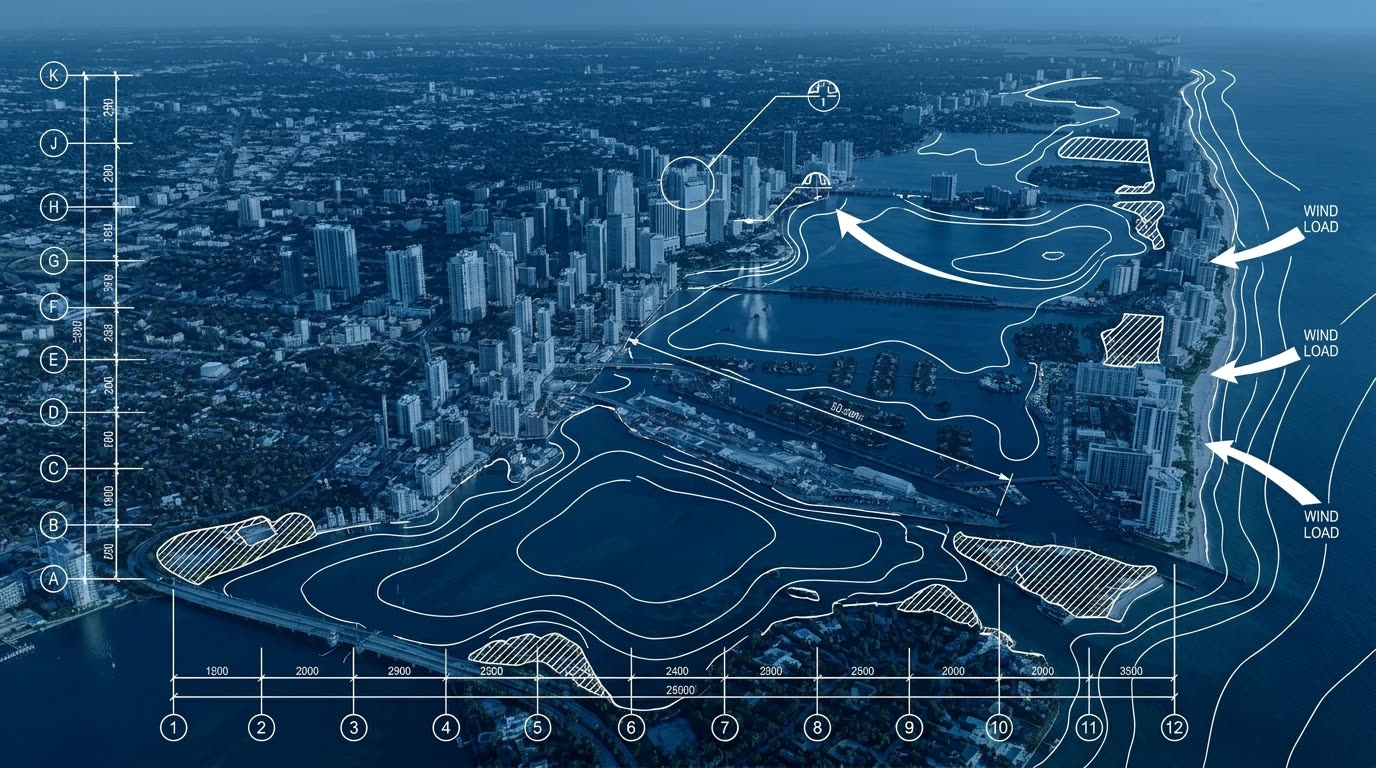
Miami-Dade County is entirely within the High-Velocity Hurricane Zone, so every window, door, roof, and structure has to be designed for HVHZ wind pressures and use products approved for the zone. It is the most demanding product-approval environment in Florida.
We work across the whole county, in the City of Miami, Coral Gables, Hialeah, Doral, and Homestead as well as the unincorporated areas, and every package is reviewed and sealed by our Engineer of Record before it leaves the office.
Start a project in Miami-Dade CountyIn Miami-Dade County
What we typically engineer here.
- Impact window and door replacements to HVHZ pressures
- Re-roofs with roof-to-wall connection and attachment engineering
- Building recertification (30-year, then every 10) for aging buildings
- Sheds, screen enclosures, and accessory-structure anchorage
Who reviews your permit
Some Miami-Dade cities run their own building departments; other areas are reviewed by the county. Postal “Miami” covers both incorporated cities and unincorporated county, so the reviewing authority is confirmed per address before work starts.
DERM and environmental review
The county's environmental agency (DERM) can attach to a permit for flood, coastal, or environmental scopes even inside a municipality. Where it applies, those reviews are handled as separate disciplines on the package.
Recertification
Under county code §8-11(f), qualifying buildings are recertified beginning at 30 years of age (25 for coastal buildings), then every 10 years, the program long known as 40-year recertification, shortened in 2022. It is separate from the statewide milestone inspection, and a building can owe both.
Code & design basis
What governs work in Miami-Dade County.
Jurisdiction-level facts below are confirmed against primary sources. Parcel-specific values such as exact wind speed, flood zone, and zoning are confirmed per project for your address.
- HVHZ
- Yes, entire county
- Product approvals
- Miami-Dade NOA, or a Florida Product Approval (FL#) with explicit HVHZ acceptance
- Wind design
- Design wind speed is a per-parcel value confirmed from the ASCE 7 hazard tool for each project, never assumed.
- Recertification
- Recertification begins at 30 years (25 coastal) under §8-11(f), then every 10 years.
- Environmental review
- DERM may review flood/coastal/environmental scopes, including inside cities.
- Flood
- Parcel flood zone / BFE confirmed from the FIRM and survey per project.
- Code
- Florida Building Code 2023 (8th Edition); ASCE 7-22 wind provisions.
Permitting & review
Building review in Miami-Dade County.
Who reviews permits
Miami-Dade County RER (Regulatory and Economic Resources) reviews permits in unincorporated areas, and county-level fire and environmental (DERM) review applies to many municipal permits.
Recertification
Under Miami-Dade County Code §8-11(f), qualifying buildings are recertified beginning at 30 years of age (25 years for coastal buildings), then every 10 years. This is the program long known as 40-year recertification, shortened by a 2022 amendment.
Flood
County floodplain management is governed by Chapter 11C of the county code. Parcel flood zone and base flood elevation come from the FIRM and survey per project.
Code & products
Unincorporated zoning is under Chapter 33 of the county code; DERM may review environmental scopes even inside cities.
Verified July 2026. Portals, contacts, and fees change, so confirm current details with the jurisdiction before filing. We verify the design basis for your specific parcel on every project.
Permitting & review
Permitting and building review in Miami-Dade County.
Who reviews permits
Miami-Dade County RER (Regulatory and Economic Resources) reviews permits in unincorporated areas, and county-level fire and environmental (DERM) review applies to many municipal permits.
Recertification
Under Miami-Dade County Code §8-11(f), qualifying buildings are recertified beginning at 30 years of age (25 years for coastal buildings), then every 10 years. This is the program long known as 40-year recertification, shortened by a 2022 amendment.
Flood
County floodplain management is governed by Chapter 11C of the county code. Parcel flood zone and base flood elevation come from the FIRM and survey per project.
Local code
Unincorporated zoning is under Chapter 33 of the county code; DERM may review environmental scopes even inside cities.
Verified July 2026. Permit portals and department details change, so confirm current information with the jurisdiction before filing. Parcel-specific values are confirmed per project.
Services
What we engineer in Miami-Dade County.
Common questions
Miami-Dade County, FAQ
Is my Miami-Dade project in the HVHZ?
Yes, all of Miami-Dade County is in the High-Velocity Hurricane Zone, so opening protection and HVHZ-valid product approvals apply. The exact design pressures still depend on your address and building height, which we confirm per project.
Do Miami-Dade permits require a Miami-Dade NOA?
Products must carry an approval valid for the HVHZ, either a Miami-Dade NOA or a Florida Product Approval with explicit HVHZ acceptance. We verify approvals against the current source for each product rather than a cached listing.
Does the county or the city review my permit?
It depends on the address. Several Miami-Dade cities have their own building departments; other areas are reviewed by the county. We confirm the reviewing authority for your parcel before starting.
Does my older Miami-Dade building need recertification?
Under county code §8-11(f), qualifying buildings are recertified beginning at 30 years of age (25 for coastal buildings), then every 10 years, the program formerly known as 40-year recertification, shortened in 2022. Whether, and when, your building is due depends on its age, size, and location, which we confirm.
Working on a project in Miami-Dade County?
Send the address and scope. We confirm the requirements for your parcel and jurisdiction.
Prefer to talk? Call 305-393-0690